Expertise provided by Dr. Moshos, Owner
Maybe you’ve been putting off the dentist because the last office handed you a long treatment plan, and you honestly couldn’t tell what was real and what was a sales pitch. Maybe you’re also wondering if a fancy 3D scan is just one more thing to get billed for. We get that at Rivers Edge Dental, and we hear it all the time. So we’re just gonna tell you how it is: we’re not gonna upsell anything off a scan. The whole point of the scan is to see clearly so nobody has to guess, and that includes you.
If you typed something like “cone beam CT dental Cornelius” into a search bar and ended up reading about a practice in Mooresville, NC, this guide walks you through what the scan is, what it shows, what it costs, and why we use it the way we do. At Rivers Edge Dental, Dr. Moshos takes a 3D cone-beam CT scan on new adult patients before planning treatment. This isn’t a revenue add-on. The scan shows exactly where your nerves run, whether your bone appears ready for an implant, and whether a root canal may have failed years ago even though the tooth doesn’t hurt yet, and a standard 2D x-ray can miss all of those things.
This guide covers what we actually look at on the scan, the measurements that drive our decisions, how much radiation is involved, and how insurance tends to handle it.
What Is Cone-Beam CT, and Why Does Rivers Edge Dental Scan New Adult Patients?
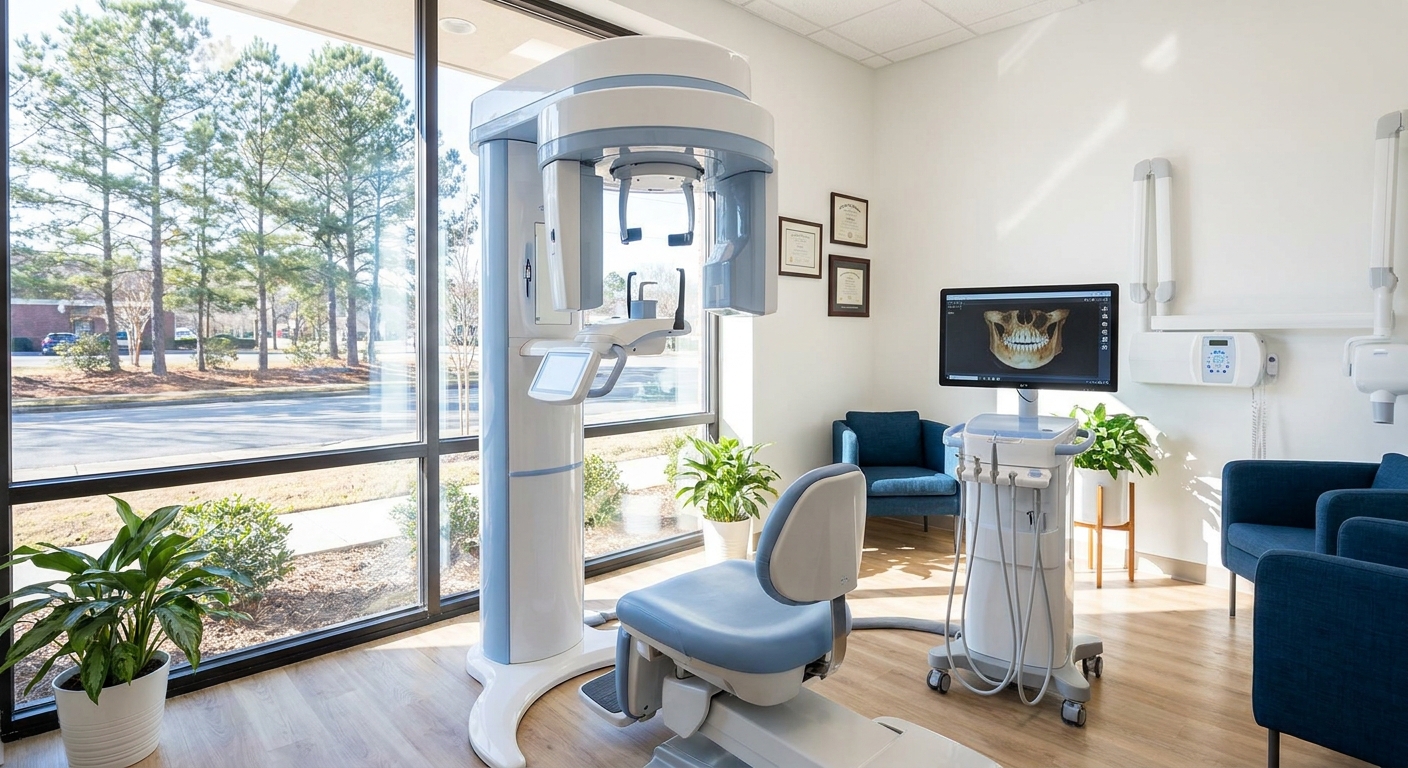
Cone-beam CT, short for cone-beam computed tomography, is a type of dental x-ray. In one quick rotation around your head, it captures your teeth, jawbone, nerve canals, and sinuses in three dimensions. We take one on new adult patients at Rivers Edge Dental because it can reveal failed root canals, missed canals, and bone defects that don’t always show up on a 2D panoramic or bitewing x-ray.
A regular dental x-ray works a lot like a shadow on a wall. Everything in its path gets flattened into one layer, so a problem hiding behind a root, or sitting on the cheek side of the bone, can disappear into the overlap. A cone-beam scan is more like a loaf of bread you can slice in any direction: front to back, side to side, or top to bottom. The FDA describes dental cone-beam CT as a way to produce 3D images of your teeth, soft tissues, nerve pathways, and bone in a single scan. Being able to turn and slice the image is the reason we use this dental technology.
Here’s a situation we see sometimes. Say you had a root canal on a lower molar ten or fifteen years ago, it’s never bothered you, and on a flat x-ray it looks fine. On the 3D scan, Dr. Moshos of Rivers Edge Dental can rotate to a side view and sometimes spot a dark area at the tip of one root, and that’s basically the bone telling us an infection may have been working there quietly. Upper molars are another common example. They sometimes have an extra small canal that’s easy to miss during a root canal, and an untreated canal can keep bacteria hanging around for years. On a 2D image that canal usually hides behind its neighbors, but on a 3D slice you can sometimes see it.
The scan doesn’t replace other imaging technologies, though. Bitewings are still the best way to catch cavities between your back teeth, and after a filling or crown we still take a postop bitewing at Rivers Edge Dental to check the margins. The 3D scan is simply a tool that answers the questions a flat image can’t. The FDA also notes that cone-beam CT uses more radiation than standard dental x-rays, so a dentist should have a real reason for every scan.
Our reason for scanning new adult patients at Rivers Edge Dental is pretty simple. Most adults who come in as new patients have some history, you know, an old root canal, a missing tooth, a wisdom tooth that never came in, or a crown nobody has checked in years. Seeing the whole picture on day one means your comprehensive treatment plan and your care start from facts instead of guesses. And when the scan shows healthy teeth, we leave them alone. I mean, we wouldn’t cut those teeth just because a 3D image exists. If you’re a parent booking for the whole family, know that kids don’t get a scan by default. We only image children when there’s a specific reason, like checking how adult teeth are coming in.
Can Your Bone Hold an Implant, or Will You Need Grafting First?
For a lot of adults, a big question is whether a missing tooth can be replaced with an implant. On a cone-beam scan, Dr. Moshos at Rivers Edge Dental measures the width and height of the bone where your tooth is missing. We look for enough width to support the implant and enough height that the implant wouldn’t get close to anything important, like the nerve in the lower jaw or the sinus floor in the upper jaw.
Width matters because an implant needs a solid wall of bone on both sides to stay healthy long term. If the ridge is too narrow, the implant could end up with thin or missing bone on the cheek or tongue side, and that may create problems later. Height matters because of what sits underneath. In the lower jaw, the nerve that gives feeling to your lip and chin runs through a canal inside the bone, and you don’t want an implant anywhere near it. In the upper back jaw, the sinus sits just above your roots, and after a tooth has been gone a while, that sinus floor can drop lower than you’d expect. A 2D x-ray gives a rough idea of these distances. The 3D scan lets Dr. Moshos of Rivers Edge Dental measure them in the exact spot the implant would go, from more than one angle, before anyone picks up an instrument.
Those width and height measurements decide your plan. When the bone appears to meet our criteria, Rivers Edge Dental can plan and place your implant right here in our office, which is more convenient because you don’t have to start over with a new office, new paperwork, and new faces. We usually schedule the implant for a separate appointment so you have time to get comfortable with the plan. If it makes sense, we can also phase it so you maximize both years of benefits on your insurance.
Then there’s the in-between case, where the bone is close but falls a little short of our height criteria. Say the scan shows only 6 mm of bone between the ridge and your sinus floor in the upper jaw. Normally that would mean a separate, bigger sinus lift procedure. Dr. Moshos at Rivers Edge Dental can sometimes handle a small lift from inside the implant site using special bone-condensing burs that spin in reverse. Instead of carving bone away, these tools press and pack it, gently nudging the sinus floor up a little so there’s room for the implant. When the bone is thinner than that, we’ll tell you straight. Bone grafting and ridge preservation are services available in our office, and when a case truly needs more than that, we’ll explain why and point you to a trusted local specialist. Research such as this updated review of dental cone-beam CT lists implant planning as one of the main uses for the technology, and the reason is exactly this kind of millimeter-level decision.
Is the Radiation From a Cone-Beam Scan Something You Should Worry About?
Any time the word “scan” comes up, it’s natural to wonder about radiation. A dental cone-beam scan uses more radiation than a set of bitewings but far less than a regular medical CT scan of the head. The exact dose depends on the machine and how much of your head the scan captures. For a focused dental scan, the exposure usually works out to a few days or a few weeks of the natural background radiation everyone absorbs just by living on Earth.
To put numbers on it, the U.S. Nuclear Regulatory Commission estimates that the average person in the United States gets roughly 3 millisieverts a year from natural sources like the ground, the air, and space. That’s a little under a hundredth of a millisievert per day. Published estimates for dental cone-beam scans vary a lot by machine and scan size. They range from a few hundredths of a millisievert for a small, focused scan up to several tenths for a large scan that captures the whole skull. Review articles, including this one on cone-beam CT basics and applications in dentistry, consistently describe dental cone-beam doses as lower than medical CT. The StatPearls review of dental cone-beam CT also explains how the size of the scanned area changes the dose.
We’re giving you real numbers because vague reassurance isn’t good enough. If you’ve ever been told “it’s nothing, don’t worry about it” and felt brushed off, that’s a fair reaction. The honest answer is that the scan is a small, measurable dose. The guiding rule in dentistry is to keep radiation as low as reasonably possible while still getting the information you need, and one scan that shows your nerves, sinuses, and bone can replace a guessing game of extra 2D films taken from different angles.
A few practical points are worth knowing. If you’re pregnant or think you might be, tell us before any imaging so we can talk through timing. If you’ve had a cone-beam scan at another office recently, bring it to Rivers Edge Dental or let us know, because there’s no reason to repeat good imaging. And if you ever have questions about why a scan is being taken, just ask, because you should always get a clear answer about why we’re recommending something.
What Actually Happens During the Scan, Even If You Hate Tight Spaces?
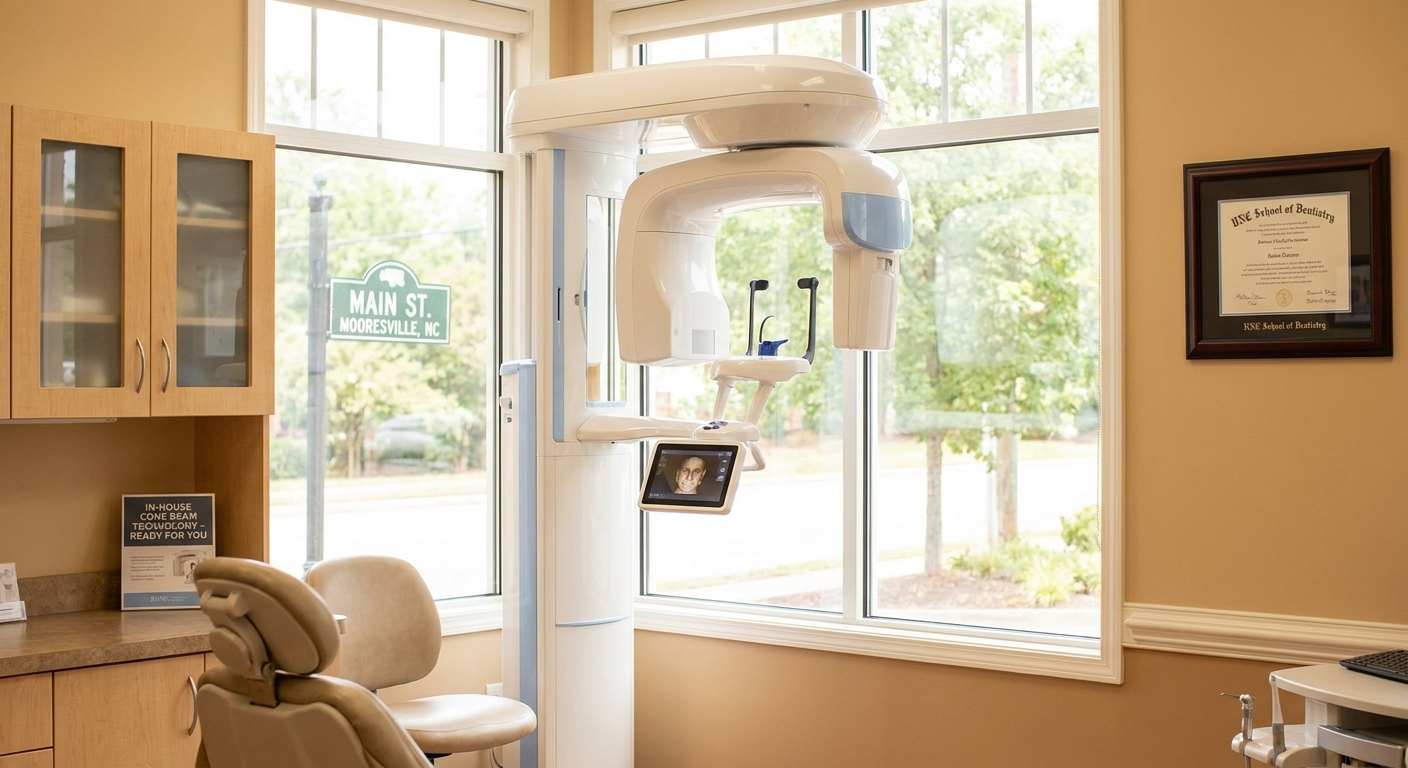
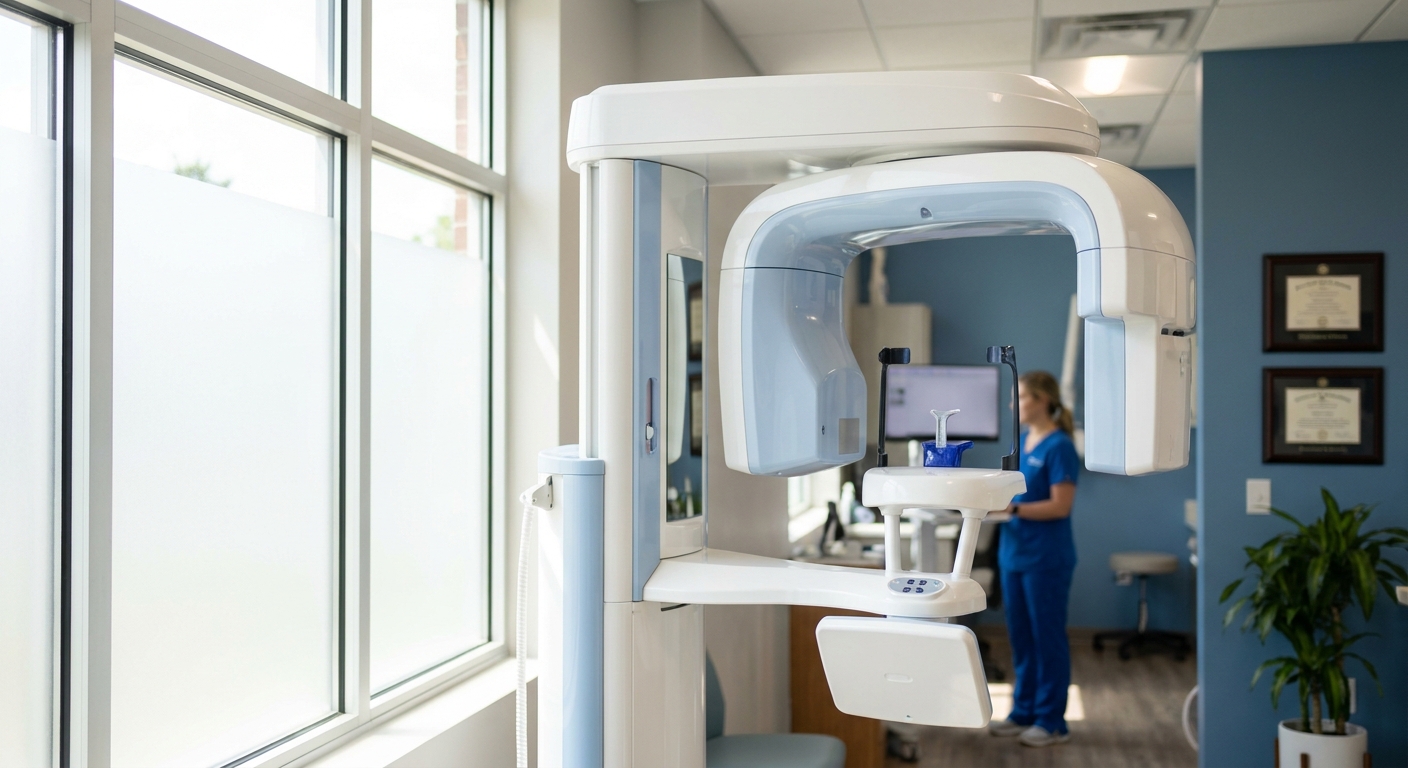
Knowing what to expect takes a lot of the worry out of the cone-beam scan experience. The scan takes well under a minute, usually about 20 seconds of the arm actually moving, and the machine is open on all sides. You hold still with your chin on a small rest while the arm circles your head once, and then you’re done.
Here’s how it goes from start to finish. First, you’ll take off anything metal around your head and neck, like earrings, necklaces, glasses, hairpins, and hearing aids. If you wear a removable partial or denture, that comes out too, because metal and acrylic can blur the image. Depending on the machine, you’ll either sit or stand. Our Rivers Edge Dental team lines you up with your chin on a rest and has you bite gently on a small guide so your head stays steady, and they’ll tell you what’s about to happen before it happens. Then the arm makes one slow pass around your head with a soft whirring sound. Your only job is to stay still, breathe normally, and try not to swallow until it stops. Afterward, the image data goes straight to the computer, and Dr. Moshos can scroll through the slices with you and show you exactly what we’re seeing.
If tight spaces make your heart race, the setup of the machine should help. A dental cone-beam machine is nothing like an MRI tunnel. There’s no tube to slide into, nothing closes around you, and you can see the room the whole time. Nothing touches your face except the chin rest and the bite guide, and if you need a break at any point, just say so and we’ll stop, reset, and go again when you’re ready.
For a lot of our patients, the scan isn’t really the scary part. It’s everything a dental visit brings back up. If that’s you, you’re not alone with this fear, it’s super common. When you call Rivers Edge Dental, the front desk notes that you’re anxious or that it’s been a while, so everyone you meet already knows before you sit down. We basically get to know your dental concerns and your history before we do anything, and we meet you halfway on pacing, explanations, and breaks. For patients who need more help relaxing during treatment, nitrous, oral sedation, and IV sedation are also available. That’s what comfort-focused, anxiety-aware care looks like for us in real life, and honestly, when an anxious patient leaves saying “that wasn’t bad at all,” those are the moments we appreciate most.
Will Insurance Cover Your Cone-Beam Scan, and What Will You Actually Pay?
Cost is a common worry, and most people want to know what they’ll pay for a cone-beam scan. The answer depends on your plan and why the scan is taken. Some dental plans pay for cone-beam imaging when it’s tied to implant planning, wisdom teeth, or another surgical procedure. Others treat it as diagnostic imaging and won’t pay for it, which leaves the fee to you. Rivers Edge Dental checks your coverage for the scan before your appointment and tells you your out-of-pocket cost up front.
Insurance companies don’t handle cone-beam CT like a routine set of x-rays. Dental offices bill it under its own procedure codes, such as D0367 for a scan that captures both jaws, and each plan decides how it handles those codes. You’ll commonly see a few patterns: some plans cover the scan when the claim shows it’s part of planning an implant or removing an impacted tooth, some limit how often they’ll pay for it, and some exclude it entirely. Two people with the same insurance company can even get different answers because their employers chose different plans, so we check the details at Rivers Edge Dental instead of guessing.
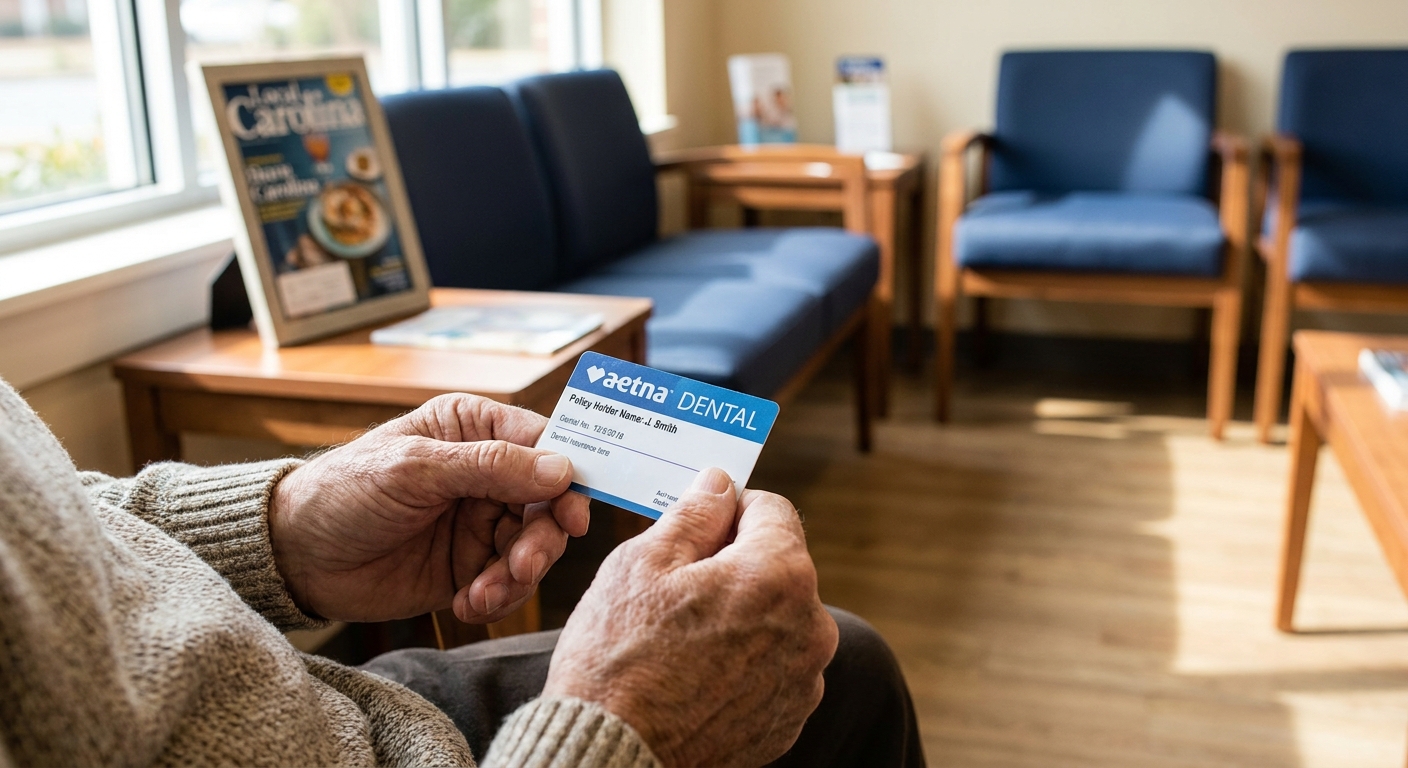
Rivers Edge Dental accepts UnitedHealthcare, Delta Dental, Aetna, Principal, and BlueCross BlueShield of North Carolina. When you call, the front desk takes your member ID and group number and looks up how your plan handles cone-beam imaging. If your plan pays, you’ll know roughly how much. If it doesn’t, you’ll know before you’re in the chair, not when a bill shows up weeks later. Nobody likes surprise charges, and this way you won’t get one.
If you’d rather call your insurance company yourself, here are the questions worth asking:
- Does my plan cover cone-beam CT, and under which service category?
- Is there a limit on how often it’s covered?
- Does it need to be tied to a specific procedure, like an implant or extraction, to be covered?
- Does a deductible apply first?
The scan helps you plan your budget, too, not just your treatment. Because Dr. Moshos at Rivers Edge Dental sees the full picture at your first visit, your comprehensive treatment plan can be laid out in order of what’s urgent and what can wait. When work needs to happen in steps, we’ll phase it so you can maximize both years of benefits instead of hitting your annual limit all at once. If you’d like a sense of what finished work looks like, you’re welcome to browse our before-and-after gallery too.
Cone Beam CT Dental Cornelius FAQs: What Patients Ask Before Coming to Mooresville
Whether you searched for cone beam CT dental Cornelius or a dentist in Mooresville, NC, these are the questions we hear most often about cone-beam CT at Rivers Edge Dental.
Does dental insurance cover cone-beam CT scans in Mooresville, NC?
Coverage depends on your insurance company, your specific plan, and the reason for the scan. Some plans pay when the scan is part of implant planning or checking an impacted tooth, while others treat it as diagnostic imaging and deny it. Rivers Edge Dental checks your benefits before your appointment and tells you your out-of-pocket cost up front.
How much radiation do I get from a cone-beam CT scan?
A dental cone-beam scan uses more radiation than bitewings and much less than a regular medical head CT. The dose varies by machine and scan size. A focused dental scan usually equals a few days or weeks of natural background radiation, which the U.S. Nuclear Regulatory Commission puts at roughly 3 millisieverts a year.
What does a cone-beam CT scan show that a regular dental x-ray can’t?
It shows your bone, roots, nerve canals, and sinus floor in three dimensions, so Dr. Moshos can measure bone width and height for implants. It can also sometimes reveal infection around an old root canal, missed canals, and bone defects that may stay hidden behind overlapping structures on a flat panoramic or bitewing image.
Will I feel claustrophobic during a cone-beam CT scan?
Most people find it much easier than an MRI. The machine is open on all sides, nothing closes around you, and you can see the room the whole time. The arm circles your head once in under a minute, and if you need a pause, just tell the team and they’ll start again when you’re ready.
When does a dentist use cone-beam CT instead of regular x-rays?
Dentists commonly use cone-beam computed tomography for implant planning, complicated root canals, wisdom teeth or impacted teeth near the nerve, bone grafting decisions, and any procedure that needs precise mapping of nerves or sinuses. At Rivers Edge Dental, we use it for new adult patients, and we still use bitewings to check for cavities between teeth.
How long does a cone-beam CT scan take at Rivers Edge Dental?
The scan itself takes about 20 seconds while the arm makes one pass around your head. Getting positioned and removing glasses or jewelry adds a few minutes. Afterward, the 3D images are ready on the computer so Dr. Moshos can go over them with you.
When you’re ready, call Rivers Edge Dental at (704) 230-1470 or fill out our online contact form to schedule your new-patient appointment in Mooresville, NC. Request a coverage check for your cone-beam scan, and the front desk will verify your benefits and give you your out-of-pocket cost before you come in. At your first visit, Dr. Moshos will take the scan, go through the 3D images with you, and explain what they show about your bone, your nerve pathways, and any possible hidden problems before recommending any treatment. Before you call, take a minute to think back on any old root canals, crowns, or missing teeth you’ve had, even ones that never hurt, and tell us about them. If you started out searching for cone beam CT dental Cornelius, here’s the one thing we’d want you to remember: those quiet, painless old spots are where a 3D scan may find something a flat x-ray couldn’t.
See What Traditional X-Rays Can’t Show
If your dentist has recommended cone-beam imaging or you’re curious whether advanced 3D scans might help diagnose what’s been hard to pinpoint, the team at Rivers Edge Dental in Mooresville can walk you through the process and what it reveals. A quick call gives you clarity on whether cone-beam CT makes sense for your situation.
Individual diagnostic findings, treatment needs, and insurance coverage vary; outcomes and costs depend on each patient’s unique anatomy, oral health, insurance plan details, and clinical circumstances.