Expertise provided by Dr. Moshos, Owner
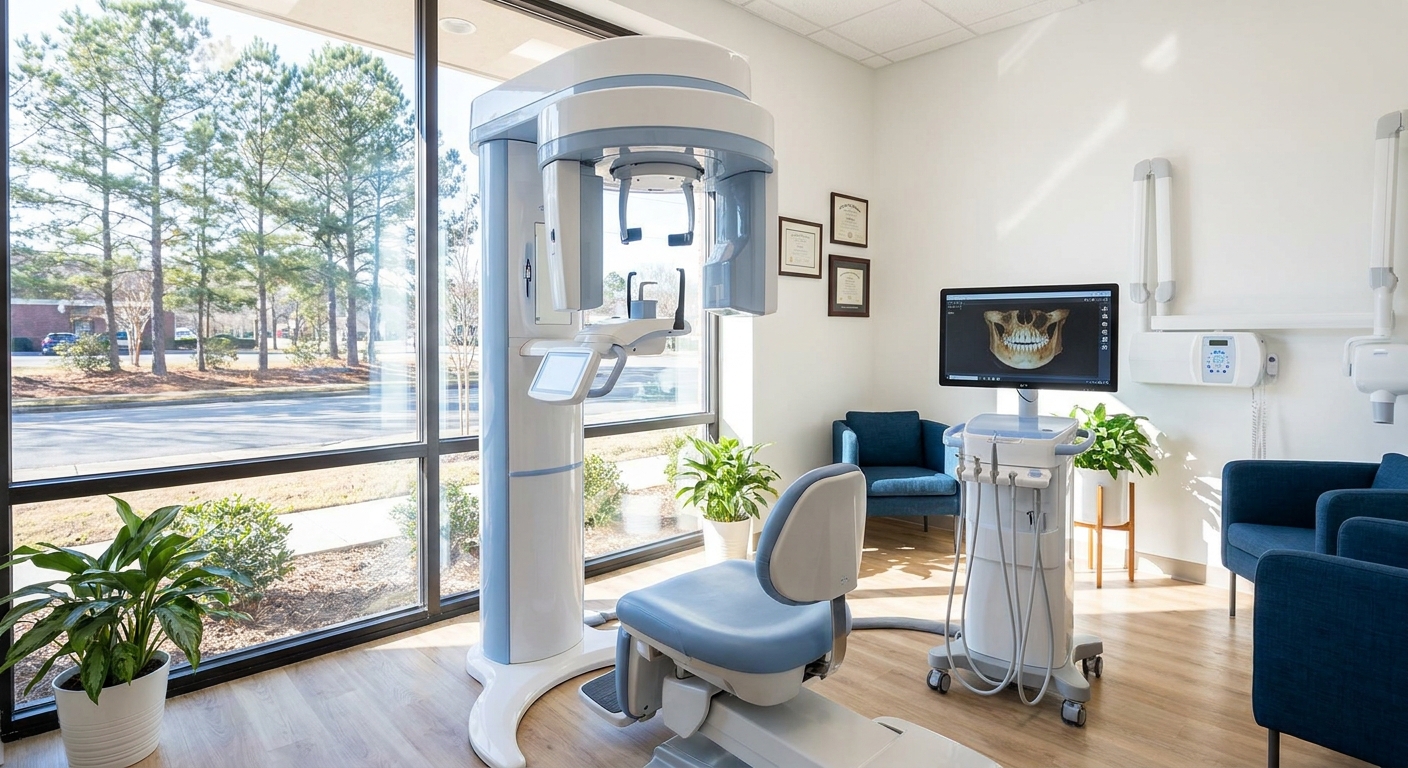
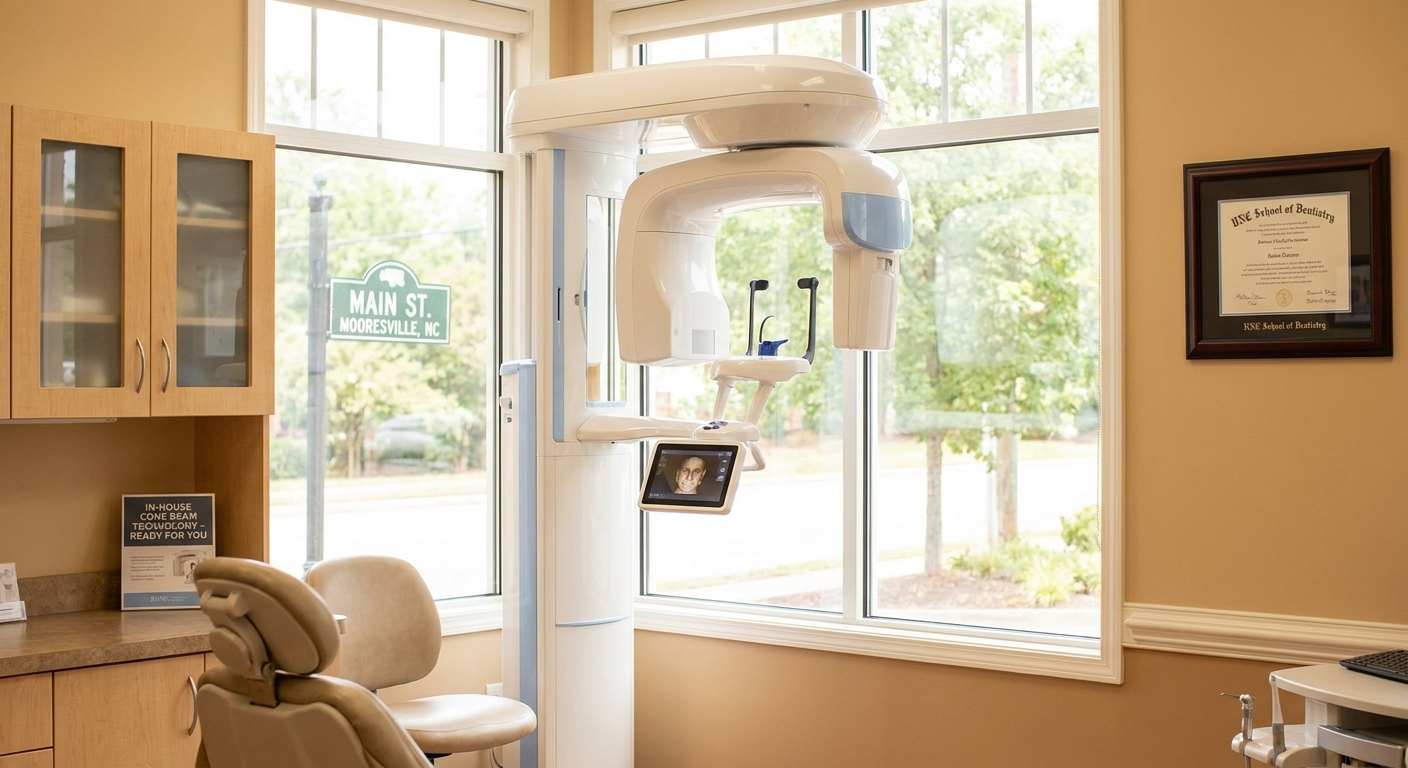
You’ve been told you need an implant, and you’re probably sitting there wondering how many appointments it’ll take, how many offices you’ll have to drive to, what it’s going to cost, and whether it’s going to hurt. A lot of the time, the first thing that helps clarify some of those questions is a 3D scan. Many adults who sit for a cone beam scan in our Rivers Edge Dental Mooresville, NC office find that it reveals details a flat 2D X-ray didn’t show them. Sometimes it’s an old root tip that was never fully removed, or a missed canal that has been holding onto infection for years. If you’re missing a tooth, though, one of the things the scan provides is your exact bone measurement. That number helps Dr. Moshos assess whether you may have enough width and height for an implant without grafting, whether your sinus sits too close, and where your nerve runs, so the surgery can be planned to the millimeter. That’s really what people searching for cone beam CT dental Lake Norman options are after, and at Rivers Edge Dental it happens in-house, the same day, without a referral.
Maybe you’ve put this off for a while because a past visit left you feeling judged or scared. If so, you’re not alone with this fear, it’s super common. A lot of the people we see at Rivers Edge Dental for implant planning have a story just like yours, and we basically get to know your dental trauma before we ever talk about treatment. Once the scan shows what’s going on, you know, the scan can help reduce some of the uncertainty, and that can help with worry too.
So here’s what we’ll walk through: what the scan shows, why it matters for your implant, what it costs, how insurance handles it, and how getting it done at your regular family dentist cuts out the referral shuffle.
What Can a Cone Beam Scan See That Your Old X-Rays Never Could?
A cone beam CT scan builds a 3D model of your jaw. It measures the width and height of your bone, the path of your nerve, and the distance to your sinus, which a flat 2D X-ray can only estimate. Those measurements help Rivers Edge Dental’s Dr. Moshos assess whether an implant may fit, what size may be appropriate, and whether you may need a bone graft first.
Here’s a simple way to picture it. A regular dental X-ray is like the shadow your hand casts on a wall. You can tell it’s a hand and you can see the outline of the fingers, but you can’t tell how thick your hand is or what’s behind it. A cone beam scan is more like holding your hand up and turning it around in the light, so you see the front, the side, and the thickness all at once. For an implant, thickness is basically one of the key questions, because the implant has to sit inside the bone with enough bone wrapped around it on every side.
The numbers Rivers Edge Dental’s Dr. Moshos looks for are specific. Standard narrow implants are about 3.5mm wide, and to hold one securely you generally want a bone width of at least 6mm, with 7mm being better. If you do the math on a 3.5mm implant in 6mm of bone, you’re left with about 1.25mm of bone on each side, which is the bare minimum. A 2D film can’t show that width at all, because width runs from your cheek to your tongue, and a flat image looks straight through it.
Height matters just as much. On the lower jaw, Rivers Edge Dental’s Dr. Moshos wants at least 10.5mm of bone above the inferior alveolar nerve, which is the nerve that gives feeling to your lower lip and chin. On the upper jaw, he measures from the top of the ridge to the floor of the sinus, and with the technique we’ll describe a little further down, sometimes a 6mm measurement can work in some cases.
| What we need to know | What a 2D X-ray shows | What cone beam CT shows |
|---|---|---|
| Bone width (cheek to tongue) | Not visible | Measured in millimeters |
| Bone height above the nerve | Rough estimate, can be distorted | Exact distance, mapped along the nerve’s path |
| Distance to the sinus floor | Approximate | Measured at the exact implant spot |
| Hidden infection or root fragments | Often missed if overlapped | Seen from multiple angles |
| Implant size that may fit | A guess | Planned before surgery |
Those measurements lead straight to a sizing decision. If your bone is 6 to 7mm wide, a standard or narrow implant may fit. If you have more width, like at a back molar spot, a wider implant may provide more support for chewing in some patients. If you’re under 6mm, the scan shows that up front, so you’ll know you may need bone grafting before an implant can go in, and nobody has to find that out halfway through a procedure.
I mean, to be honest, cone beam CT isn’t perfect at everything. Metal crowns and fillings can cause streaks on the image, and the scan doesn’t show soft tissue as clearly as it shows bone. Reviews of the technology, like this one on the clinical benefits and limitations of cone-beam computed tomography, point out those same tradeoffs. That’s why we at Rivers Edge Dental still do a hands-on exam and regular bitewings for things like cavities between teeth. The 3D scan is the right tool for bone, nerves, and sinuses, which is exactly what implant planning depends on.
Do You Need a Specialist Referral for Cone Beam CT Dental Lake Norman Care in Mooresville, NC?
No. A lot of people searching for cone beam CT dental Lake Norman care assume they’ll have to go to a separate imaging center, but Rivers Edge Dental takes the scan right in our Mooresville, NC office, and Dr. Moshos plans implant cases in-house. You get the scan and your treatment plan in the same visit, without being sent somewhere else for another consultation.
Here’s what the traditional path often looks like. Your dentist tells you that you need an implant, so you get a referral slip, call a specialist’s office, and wait for an opening. At that visit you get scanned, sometimes at yet another imaging center, and then you come back again for someone to go over the results. Every step is another phone call, another drive, another waiting room, and another new face asking about a history you’ve already told twice. If you have dental anxiety, each new office means starting over with someone who doesn’t know you yet.
| Step | Typical referral route | At Rivers Edge Dental |
|---|---|---|
| Diagnosis | Your dentist | Your dentist |
| Cone beam scan | Separate office or imaging center | Same Mooresville office, same day |
| Review of scan and treatment plan | Often a second visit | Same visit |
| Implant placement | Specialist’s office | Same Mooresville office |
| Who knows your comfort needs | A new team at each stop | The team you already know |
The reason we can do this is training. Rivers Edge Dental’s Dr. Moshos completed MaxiCourse implant training, and that advanced training is why our implant planning stays in-house. When he reads your scan, he’s the same person who will place your implant, so he isn’t handing measurements off to someone across town. That matters, because small details in your scan, like a sinus that dips a little more on one side, affect decisions that get made right there in the chair.
One thing we want to be clear about: the scan tells us right away whether there may be enough bone for an implant, but we at Rivers Edge Dental usually schedule the implant itself for its own visit. That gives you time to ask questions, look at your insurance numbers, and decide whether you’d like nitrous, oral sedation, or IV sedation for the procedure. Basically, we’d rather you walk in for surgery calm and informed than feel rushed into it that same afternoon. And because we’re the whole family dentist, the office that places your implant is the same one that cleans your kids’ teeth, so you’re not adding another office to your already full calendar.
If your scan ever shows something more complex than we should handle here, we’ll tell you that plainly and point you to a trusted local specialist. We’re just gonna tell you how it is either way.
Your Sinus Sits Low or Your Nerve Runs Close: Does That Rule Out an Implant?
Not always. A low sinus floor or a nerve that sits close to the ridge doesn’t always rule out an implant. The 3D scan lets Rivers Edge Dental’s Dr. Moshos adjust the surgical plan before the first incision, whether that means a shorter implant, a different angle, or a small, controlled sinus lift.
Let’s start with the upper back teeth. Your sinuses sit right above the roots of your upper molars and premolars. After a tooth is lost, the bone in that spot tends to shrink, and the sinus can settle lower into the space. That’s why people who lost an upper molar years ago often hear they “don’t have enough bone.” On a 2D X-ray, it’s hard to tell how much room is really there. On the cone beam scan, Rivers Edge Dental’s Dr. Moshos measures the exact distance from the top of your ridge to the sinus floor at the precise spot where the implant would go.
This is where a specialized drill system comes in. It uses reverse-cutting burs, so instead of carving bone away, it gently pushes the sinus membrane up a small amount, which we at Rivers Edge Dental call a sinus bump, while keeping and packing the bone you already have. Because of that technique, a 6mm measurement from ridge to sinus can sometimes be enough to work with, depending on the case. Without it, a lot of these patients would be told they need a full sinus lift as a separate surgery, often at a separate office, before the implant could even be scheduled. So knowing your measurement ahead of time means we can plan the bump instead of finding out mid-procedure.
The lower jaw has a different concern, which is the nerve. It runs through the bone of your lower jaw and gives feeling to your lower lip and chin, and drilling too close to it is the kind of problem nobody wants. So Rivers Edge Dental’s Dr. Moshos maps the nerve’s path on the scan and confirms there’s at least 10.5mm of bone above it. If you’re a little short, the plan might use a shorter implant or a slightly angled placement to stay well clear. All of that happens on a screen, before you’re ever in the chair for surgery.
For you, this means the “no” you might have heard before may really have been “we couldn’t see well enough to say yes.” The scan gives you a clearer answer either way, based on your actual anatomy.
What If the Scan Finds a Problem Nobody Told You About?
It happens a lot, and finding it now is a good thing. Because we scan new adult patients at Rivers Edge Dental in 3D, we regularly find failed root tips, missed canals, and bone loss that never showed up on 2D films. Those get treated or extracted first, so your implant site heals properly before anything goes in.
Here’s why these problems hide. A 2D X-ray stacks everything into one flat picture, so roots, bone, and old dental work all overlap. A small piece of root left behind from an old extraction can hide behind a neighboring tooth. A canal that was missed during an earlier root canal can sit right behind another canal and look fine, and some molars have an extra canal that’s easy to miss in two dimensions. On a cone beam scan, Rivers Edge Dental’s Dr. Moshos can scroll through your tooth slice by slice and turn it around, so those things are much more likely to show up.
This matters for implants because an implant needs clean, healthy bone to fuse with. If there’s an old root fragment or a pocket of infection near the site, placing an implant on top of it may lead to complications. So the scan might change your timeline. You might need an extraction first, sometimes with bone grafting or ridge preservation to protect the bone while it heals, and then the implant comes later. That adds healing time, but it’s healing time that gives your implant its best chance.
We’re also conservative about this, and we’re not gonna upsell anything. Sometimes the scan shows that a tooth you were told to pull may actually be saved with root canal therapy and a crown. Other times it shows that a tooth that looks fine on the surface has a problem underneath. Either way, Dr. Moshos shows you the image and explains what he sees, so you’re making the decision with the same information he has. If you’ve felt pressured at other offices, we understand, and here the scan is there to explain things, not to sell you on something.
How Much Does a Cone Beam CT Scan Cost, and What Is It Actually Like?
Now for the two questions almost everyone asks next: what does it cost, and what does it feel like? The cone beam scan is billed separately from the implant, and whether insurance helps depends on your specific plan. The scan itself takes about 15 to 20 seconds while you sit or stand still, and you leave that same visit with your treatment plan in hand.
What Cone Beam CT Costs and How Insurance Handles It
Cone beam scans have their own billing codes, separate from the implant. In the dental coding system, they’re listed as D0364 through D0367, depending on how much of your jaw the scan captures. Knowing that helps when you call your insurance company, because you can ask about those codes by name instead of asking “is a 3D X-ray covered?” and getting a vague answer.
Most dental plans treat cone beam CT as diagnostic imaging, but plans differ a lot. Some cover a portion of it under diagnostic or basic benefits, while others group it under major services. Some require pre-authorization or only pay when the scan is tied to a covered procedure, and if your plan doesn’t cover implants, it may not cover the scan used to plan one either. That’s why we verify your coverage before you commit to anything, so you know your out-of-pocket cost ahead of time and nothing on your bill surprises you. Rivers Edge Dental accepts Delta Dental, Aetna, UnitedHealthcare, Principal, and BlueCross BlueShield of North Carolina, and we’ll check your plan’s details for you. Before treatment starts, you’ll see the actual dollar amount for your scan and your implant written down, not a range.
Cost is the part that keeps a lot of people from moving forward, so we try to meet the patient halfway. Implant care often happens in stages anyway: the extraction, healing, the implant, and then the crown. When it makes sense, we at Rivers Edge Dental can phase the work across your benefit years so you maximize both years of benefits instead of using up one year’s maximum all at once. We basically just lay out a comprehensive treatment plan with real numbers, so you can see the whole picture before you decide anything.
The Patient Experience: Chair Time, Radiation Dose, and Same-Day Results
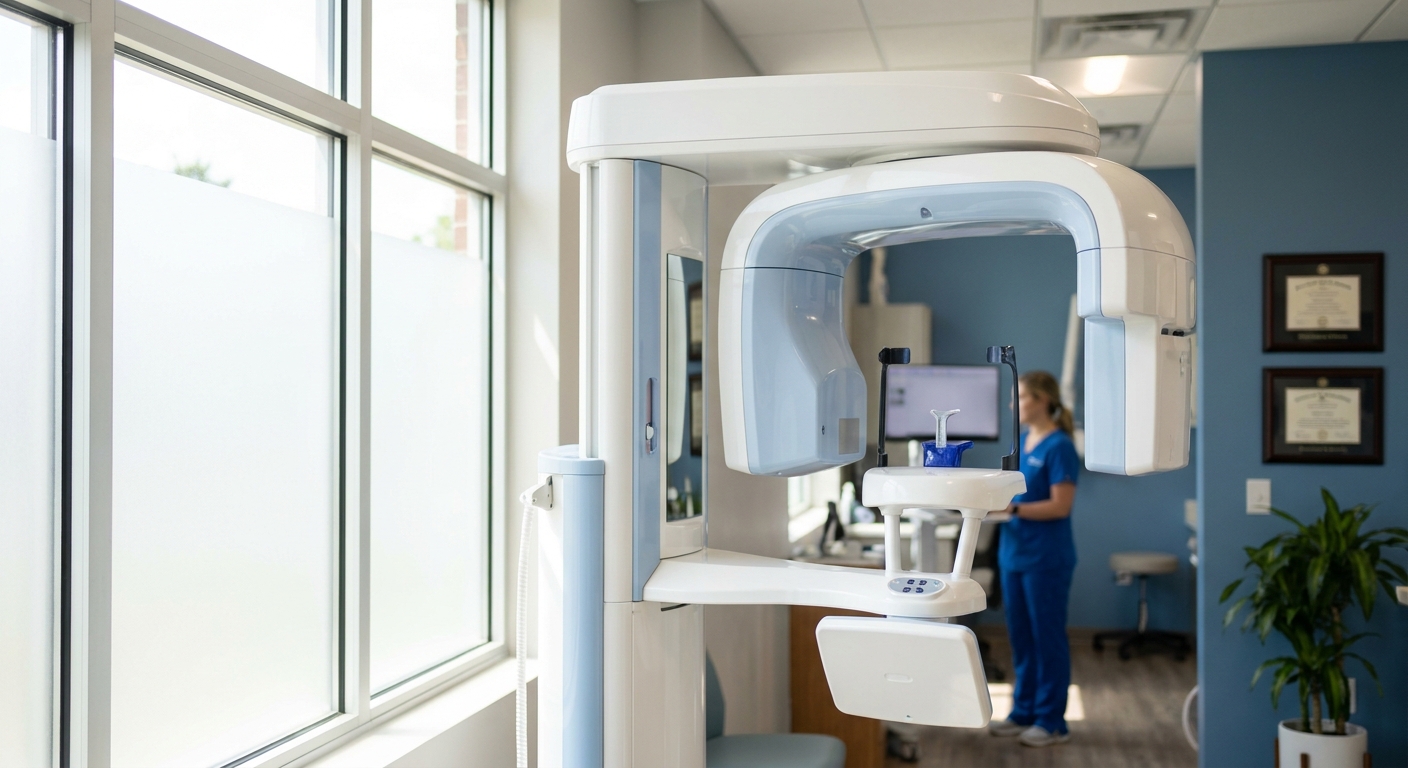
The scan itself is quick and easy. You sit or stand, rest your chin on a support, and stay still while the arm of the machine rotates around your head for about 15 to 20 seconds. There’s no tube to lie in and nothing closing in around you, so it’s very different from a hospital CT scan. If you get nervous at the dentist, you know, this is one of the easiest parts of the whole visit.
Radiation is a fair thing to ask about. The FDA explains that dental cone beam CT generally uses more radiation than a standard dental X-ray but less than a conventional medical CT scan. Guidance from the American Dental Association and the American Academy of Oral and Maxillofacial Radiology encourages dentists to choose imaging based on each patient’s needs and to keep exposure as low as reasonably possible. For implant planning, the 3D information directly shapes your surgery, which is why the scan can be valuable. If you want to know more about the dose for your scan, just ask, and we’re happy to talk it through.
Once the scan is done, Rivers Edge Dental’s Dr. Moshos pulls it up on screen and goes through it with you. He’ll show you your bone width and height, where your nerve or sinus sits, and anything else the scan turned up. You’ll leave that visit with your plan, including what implant size may make sense, whether grafting or a sinus bump is part of it, and what needs to happen first. If you’d like to see how other patients’ cases turned out, ask to look through our before-and-after photos while you’re here.
Straight Answers to the Questions Implant Patients Ask Us Most
These are the questions we hear most from people in Mooresville, NC who come to us after searching for cone beam CT dental Lake Norman options. Each answer is short so you can find what you need quickly.
Do I need a specialist referral to get a cone beam CT scan for dental implants in Mooresville, NC?
No. Rivers Edge Dental takes cone beam scans in our Mooresville office and plans implant cases in-house. You won’t be sent to a separate imaging center or an oral surgeon just to get scanned and planned, and you get the scan and the treatment plan in the same visit.
How much does a dental cone beam CT scan cost, and will my insurance cover it?
The scan is billed separately from the implant under its own codes, D0364 through D0367. Many plans cover part of it as diagnostic imaging, but coverage varies a lot by plan. We verify your benefits before treatment so you know your out-of-pocket cost up front.
What does the cone beam scan show that decides whether I can get an implant?
It measures bone width, which we generally look for to be at least 6mm and ideally 7mm for a standard narrow implant. It also measures bone height above the nerve, which we want to be at least 10.5mm, and the distance to your sinus floor. Together, those help decide your implant size and whether grafting may be needed.
Can a general dentist use cone beam CT to plan and place implants, or do I still need to see a specialist?
Rivers Edge Dental’s Dr. Moshos has advanced MaxiCourse implant training and uses our in-house cone beam to plan and place implants. Your diagnosis, scan, plan, and implant all happen in one Mooresville office. If your case needs more than we should handle, we’ll tell you honestly.
How does cone beam imaging at a family dentist cut down my total implant treatment time?
The scan, the treatment plan, and the implant placement all happen at Rivers Edge Dental, so you skip the referral wait, the separate imaging appointment, and the second consultation to review results. You go from diagnosis to a scheduled implant visit faster, with a team that already knows you.
What happens if the scan shows I don’t have enough bone for an implant?
In most cases, you’ll know before surgery, not during it. The scan shows whether you may need bone grafting first, or whether a narrower implant or a small sinus bump might work without a separate graft. Dr. Moshos walks you through each option and what it means for your timeline.
Ready to Find Out What Your Scan Shows?
Call Rivers Edge Dental in Mooresville, NC to schedule your cone beam CT scan and implant consultation, with no specialist referral required. Before you call, take two minutes to ask your insurance company how your plan handles codes D0364 through D0367, and gather any old X-rays or notes from past extractions or root canals near the missing tooth. Here’s why that matters: the old films show us what someone else saw in 2D, and when Dr. Moshos lines them up against your 3D scan, the difference often explains years of on-and-off sensitivity or a “no” you heard somewhere else. So you walk out with a clear plan, real numbers, and no surprises, from a team that will still be your family’s dentist long after the implant is in.
See What Cone Beam CT Can Reveal About Your Implant Options
If you’ve been wondering whether dental implants are right for you, or if your case requires more detailed imaging than traditional x-rays can provide, cone beam CT technology at Rivers Edge Dental offers the clarity you need. Our Mooresville team uses this advanced 3D imaging to plan implant placement with precision, helping you move forward with confidence in your treatment. Reach out today to discuss how this technology can support your smile goals.
Individual results vary, and outcomes depend on each patient’s specific anatomy, health, and circumstances.