Most people assume a missing tooth is a cosmetic problem they can deal with later. A 2019 study published in the Journal of Dental Research found that adults with untreated tooth loss experience measurable declines in oral function, nutritional intake, and systemic health within three years of the initial loss. How long you can leave a missing tooth unreplaced is not really a question about aesthetics. It’s a question about how much structural and systemic damage you’re willing to absorb before the options narrow.
What Happens When You Leave a Missing Tooth Unreplaced
Here’s what most patients don’t realize: the damage from a missing tooth doesn’t wait for you to notice it. It begins immediately, runs on multiple tracks simultaneously, and compounds over time. Bone resorbs. Neighboring teeth shift. Bite mechanics change. Nutritional habits adjust to avoid discomfort. Each of these changes makes future treatment more complex and more expensive.
This guide walks through the full timeline, from the moment of extraction forward, so you understand exactly what’s at stake and when your window for the simplest solutions starts to close.
What you’ll learn here:
- How fast bone loss begins and what rate to expect
- How surrounding teeth move into the gap and why that matters
- The downstream effects on chewing, nutrition, and jaw joints
- How your facial structure changes over years of untreated bone loss
- The systemic health research linking tooth loss to serious medical conditions
- A clear timeline with specific thresholds
- Which replacement options are available at each stage
How Fast Bone Loss Begins After Tooth Loss
A 2018 systematic review published in Clinical Oral Implants Research, analyzing data from over 4,700 extraction sites, confirmed that alveolar bone resorption begins within the first few weeks after a tooth is removed. The mechanism is straightforward: the root of your tooth transmits mechanical force into the jawbone every time you bite and chew. That stimulation signals the bone to maintain its density. When the root is gone, the signal stops, and the bone begins to resorb.
The most commonly cited benchmark in clinical literature is a 25% reduction in bone width during the first year after extraction, with up to 60% of total bone height and width lost over the following two to three years. The rate is fastest in the first three to six months. After that, the pace slows, but it does not stop.
The practical takeaway is this: the clock starts at extraction, not at the moment you decide to act. Every month without a replacement is a month of bone volume you cannot recover without surgical intervention.
What Bone Loss Means for Your Future Treatment Options
Dental implants require a minimum threshold of bone volume and density to anchor successfully. A 2020 study in the International Journal of Oral and Maxillofacial Implants found that patients who delayed implant placement beyond 12 months post-extraction had significantly higher rates of requiring bone grafting before implant surgery, with graft procedures adding an average of four to six months and several thousand dollars to the treatment timeline.
Bone grafting works. It is not a failure state. But it adds surgical complexity, healing time, and cost that would not exist if treatment had started earlier. If you are not sure whether delay has already affected your bone volume, the specific action is to request a 3D CBCT (cone beam computed tomography) scan at your consultation. A flat X-ray does not give your dentist the dimensional information needed to assess bone volume accurately. The scan does.
How Surrounding Teeth Shift Into the Gap
A 2015 study in the Journal of Periodontology tracking 238 patients over 18 months found measurable mesial drift, the migration of adjacent teeth toward a gap, in 84% of cases where no replacement was placed within six months of extraction. The mechanism is simple: your teeth maintain their position partly through contact with neighboring teeth. Remove one tooth, and the contact on either side disappears. The adjacent teeth begin to tilt into the empty space, and the opposing tooth (the one that used to bite against the missing one) begins to super-erupt, elongating downward or upward into the gap.
Shifting begins within weeks. It becomes structurally significant within months. By the time tilting is visible on an X-ray, the roots of those adjacent teeth have moved, which means any future bridge or implant must account for the new angulation. In some cases, orthodontic correction becomes a prerequisite for implant placement. What started as a single missing tooth now involves multiple teeth and multiple treatment phases.
If you’ve been unconsciously avoiding the side of your mouth with the gap while chewing, that’s already a sign that compensatory patterns have started. Don’t wait to have that evaluated.
The Effect on Your Bite, Chewing, and Nutrition
A 2016 longitudinal study published in Community Dentistry and Oral Epidemiology, following 1,400 adults over five years, found that adults missing one or more posterior teeth significantly reduced their consumption of hard vegetables, whole grains, and fibrous proteins compared to dentate controls. The mechanism is straightforward: chewing becomes less efficient, so the brain selects softer, easier-to-process foods. Nutritional quality declines as a downstream consequence.
Beyond nutrition, the way you compensate for a missing tooth puts uneven stress on the teeth that remain. Consistent asymmetric chewing loads one side of the jaw more heavily than the other, increasing wear on those teeth and placing abnormal strain on the temporomandibular joint (TMJ). TMJ dysfunction, which presents as jaw pain, clicking, headaches, and limited range of motion, is a well-documented downstream consequence of untreated tooth loss.
If you’ve noticed jaw soreness after meals or started waking up with headaches, those symptoms deserve attention beyond their face value. What looks like a separate dental concern often traces back to bite changes that started with an unaddressed gap.
How a Missing Tooth Changes Your Facial Structure Over Time
A 2017 paper in the Journal of Prosthetic Dentistry documented measurable soft tissue collapse in patients with untreated posterior tooth loss as early as two years after extraction. The mechanism runs through the bone: your jawbone provides structural support for the soft tissue of your lower face. As the bone resorbs, the support underneath the cheeks and lips decreases, and the lower third of the face begins to shorten and hollow.
This is the consequence most patients underestimate, and it’s also the hardest to reverse. Bone grafting can restore volume before implant placement, but it cannot fully undo years of resorption-driven soft tissue change. The timeline is not abstract: clinically significant facial changes are observable within two to five years of untreated bone loss, and the changes accelerate with each additional missing tooth.
People often describe this as looking “older than they are.” The actual cause is structural, not cosmetic, and it responds to structural treatment.
The Link Between Missing Teeth and Systemic Health
A 2020 meta-analysis published in the Journal of the American Heart Association, pooling data from 11 longitudinal studies and over 80,000 participants, found that adults with significant tooth loss had a 34% higher risk of cardiovascular disease compared to fully dentate adults, after controlling for age, smoking, and diabetes. The proposed mechanisms include chronic low-grade inflammation from periodontal bacteria, impaired nutritional status, and the systemic inflammatory load associated with untreated bone loss and gum disease.
The cardiovascular connection is one of three well-documented systemic links. A 2019 study in the Journal of the Alzheimer’s Association found that adults with 10 or more missing teeth had a 40% higher rate of cognitive decline over a 10-year follow-up period. A separate 2021 analysis in Diabetes Care found bidirectional associations between tooth loss and glycemic control in patients with Type 2 diabetes.
These are not fringe findings or scare tactics. They are large, longitudinal, peer-reviewed studies. The practical bridge is direct: a missing tooth is a medical issue, not a cosmetic inconvenience. Treating it as a low priority carries consequences that extend well beyond your mouth. If you’ve been putting off dental care while managing other health concerns, this is why those two things are not separate.
How Long Is Too Long? Understanding the Real Timeline
Here is the direct answer to the title question, built from the clinical evidence above.
In the first three months, bone loss is active and rapid, but bone volume is still sufficient for implant placement without grafting in most patients. Adjacent teeth are beginning to shift, but the movement has not yet altered root angulation significantly. This is the optimal window.
From three to six months, bone width loss is approaching or exceeding 10 to 15%, and mesial drift is measurable. Implants remain highly viable, but a detailed bone assessment is now mandatory rather than optional. The complexity of future orthodontic correction is increasing.
At 12 months, roughly 25% of bone width has been lost. Bone grafting is required in a substantial proportion of patients before implant placement. Bite changes and compensatory chewing patterns are established. This is still treatable, but the treatment plan is now longer and more expensive than it would have been at the three-month mark.
Beyond three years, soft tissue and facial structure changes are often visible. Bone loss has progressed significantly. Implants may still be possible with grafting, but the surgical and financial investment is substantially higher. Bridges and partial dentures remain available at this stage without bone volume requirements. The question shifts from “what is the ideal treatment?” to “what options are still open to you?”
There is no single point at which options disappear. The honest answer is that options change in complexity and cost, and the change accelerates after the 12-month mark.
Your Tooth Replacement Options and When Each One Works
The three primary replacement options respond differently to delay. Understanding which one fits your situation depends on how long the tooth has been missing and what the current bone volume assessment shows.
Dental Implants
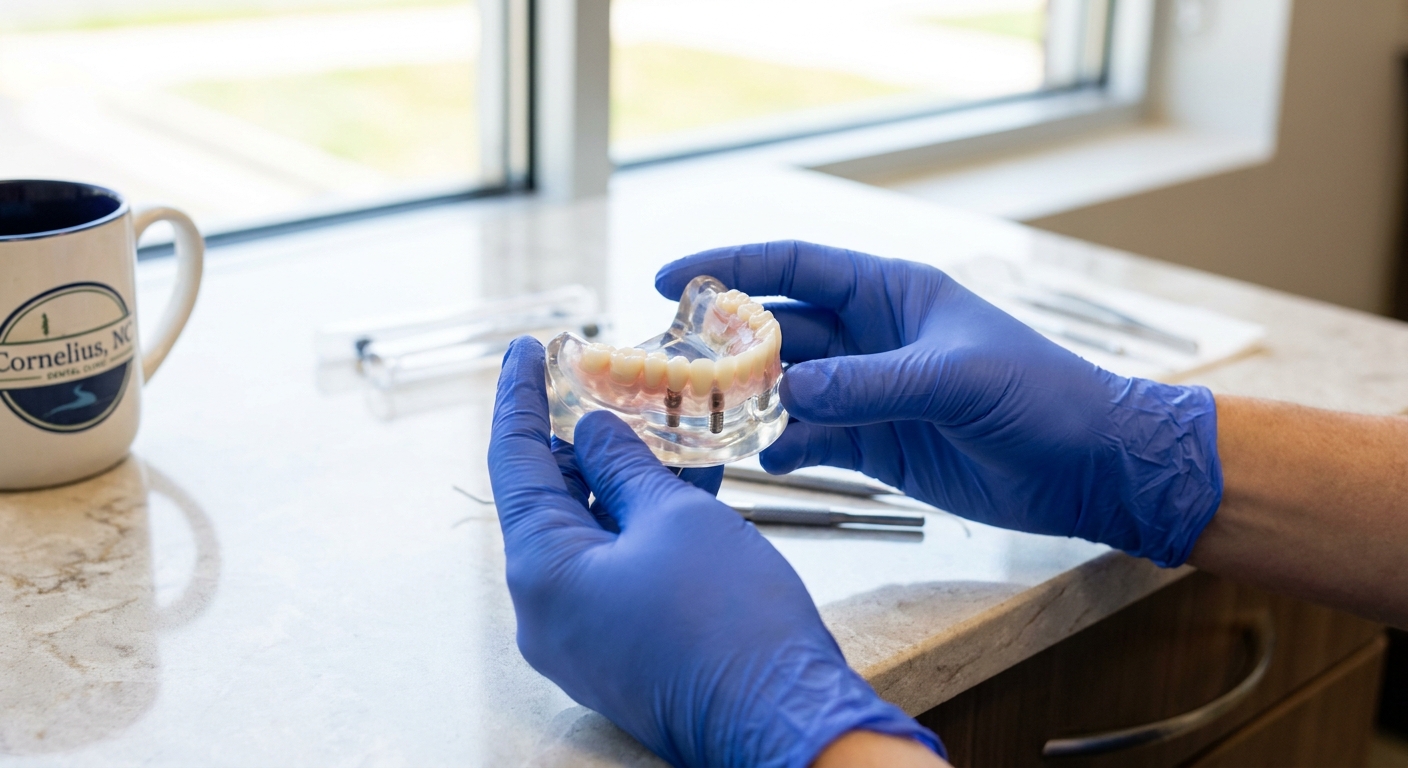
Implants replace the root, not just the crown. That distinction matters because the root is what stimulates the jawbone. A 2022 review in the International Journal of Implant Dentistry found 10-year survival rates exceeding 95% for properly placed implants in adequate bone, making them the most durable long-term solution available. Because they restore the stimulation the bone needs, they halt the resorption process rather than just filling the visible gap.
The constraint is bone volume. If you’ve been without a tooth for more than 12 months, request the CBCT scan before assuming implants aren’t possible. Many patients who believe they’ve “waited too long” for implants have more viable bone than they expect, and grafting has become a routine procedure with predictable outcomes.
Dental Bridges
A bridge spans the gap by anchoring to the adjacent teeth on either side. It does not require any bone volume at the replacement site, which makes it viable at nearly any stage after tooth loss. A 2019 study in the Journal of Dentistry reported 10-year survival rates around 89% for three-unit porcelain-fused-to-metal bridges, with modern ceramic materials performing comparably.
The trade-off is worth understanding clearly: placing a bridge requires modifying the adjacent teeth, which are otherwise healthy. And because the bridge sits above the gumline, it does not restore root stimulation to the underlying bone. Bone resorption continues beneath the bridge. It solves the functional and cosmetic problem without addressing the structural one.
Dentures and Partial Dentures
For patients missing multiple teeth, or where bone volume is insufficient for implants even after grafting, removable dentures and partial dentures provide functional coverage. A 2020 paper in Gerodontology noted that conventional dentures actually accelerate bone resorption through pressure on the ridge, though implant-supported dentures substantially reduce this effect by restoring some root-level stimulation. If removable options are your current path, the implant-supported version is worth discussing as a long-term upgrade, even if you start with conventional dentures.
Make the Call This Week
Book a consultation with a restorative dentist and come with three specific questions: how much bone volume do you have at the site, how much shifting have the adjacent teeth already experienced, and which replacement options are still viable given the current state. Those three questions will tell you more than any amount of online research. If you’re in the Mooresville or Lake Norman area, same-day consultations are available, and a proper assessment, including imaging if needed, takes less than an hour.
The options narrow gradually, not all at once. But they do narrow. Getting a clear picture of where you stand right now is the move that keeps the most options open.